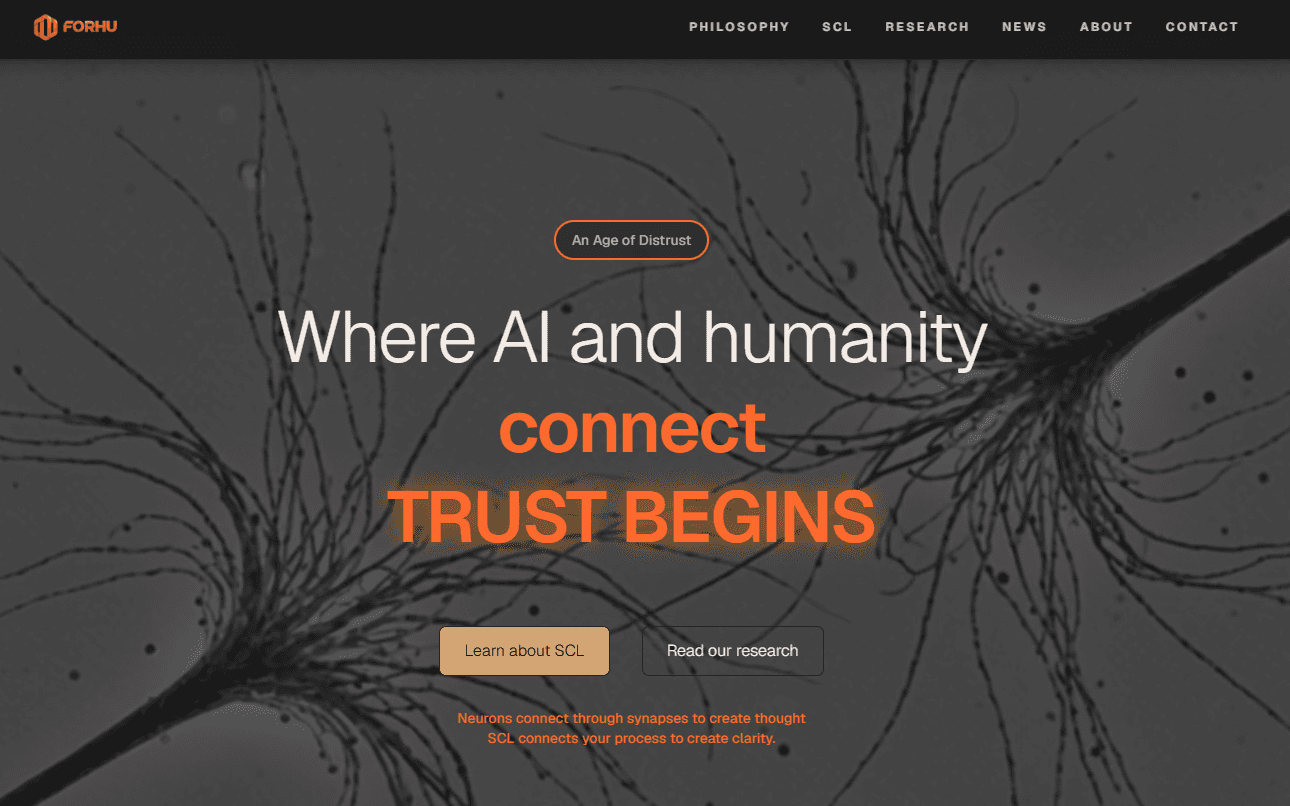
Forhu Revolutionizes AI Transparency with New Cognitive Model
September 10, 2026

The field of artificial intelligence faces a significant paradox, highlighted by the increasing intricacies of AI models alongside a growing obscurity in their internal workings. This inconsistency creates challenges for corporations, regulatory bodies, and consumers who must trust advanced technologies without a clear comprehension of their operational frameworks. With vast financial investments and considerable implications for vital human decisions, the stakes remain exceedingly high. In response to this issue, Forhu has emerged as a proactive force.
With the guiding principle of "For Human," Forhu distinguishes itself as a forward-thinking, research-based technology enterprise dedicated to the development of artificial intelligence that not only amplifies human capabilities but also respects human dignity. Rejecting makeshift approaches such as trial-and-error and relentless prompt adjustments, Forhu has launched a groundbreaking model known as the Structured Cognitive Loop, or SCL.
The company's core philosophy emphasizes the importance of transparency, asserting it must take precedence over conventional performance indicators. In an industry often obsessed with high benchmark figures and the efficiency of output production, Forhu maintains that outstanding performance lacks value if it results in indecipherable outcomes. The establishment of trust is crucial, especially in significant business situations, as a lack of trust can render even the most effective systems a liability. Consequently, Forhu has laid down a series of rigorous principles to uphold its commitment to transparency and accountability.
First, the principle of “Transparency Must Be a Given” asserts that any AI system's deployment is unacceptable unless it can explicitly convey the rationale behind its conclusions. The journey to understanding the reasoning process is deemed as pivotal as the outputs generated.
Second, the principle of “Learning from Errors” emphasizes that inconsistencies and mistakes should not be overlooked. These errors are meticulously recorded and leveraged as vital information that feeds into the system's memory and control mechanisms, preventing similar mistakes from reoccurring in the future.

Under the principle “Design Over Deployment,” Forhu insists that trust cannot be retrofitted onto an inadequate model after it hits the market; thus, genuine accountability and governance must be embedded within the cognitive framework from the very beginning.
Finally, the principle of "Upholding Human Dignity" asserts that ethical considerations must be treated as stringent requirements, integrated into the underlying design of the AI, and resistant to potential adversarial influences or prompts.
In contrast to traditional generative AI systems that predominantly rely on predictive pattern recognition, which generates next data points based on extensive training datasets, Forhu's innovative approach integrates foundational AI models with insights from cognitive science and formal epistemology. This design includes a rigorous control framework, where outputs undergo meticulous verification, memory assessments, and stringent control processes. The intention is to transform ambiguous predictions into transparent reasoning that is auditable.
With the ongoing integration of AI technologies into societal frameworks, Forhu is at the forefront of transitioning from the historically opaque "black box" model toward a more transparent, accountable, and human-centered approach characterized as the "Glassbox." This pivotal movement signifies a shift not merely towards trusting AI technologies but fostering a profound understanding of them.
Share this article