Technology
GeomeeGo Innovates Travel Booking with Enhanced Accountability
September 17, 20266 min read
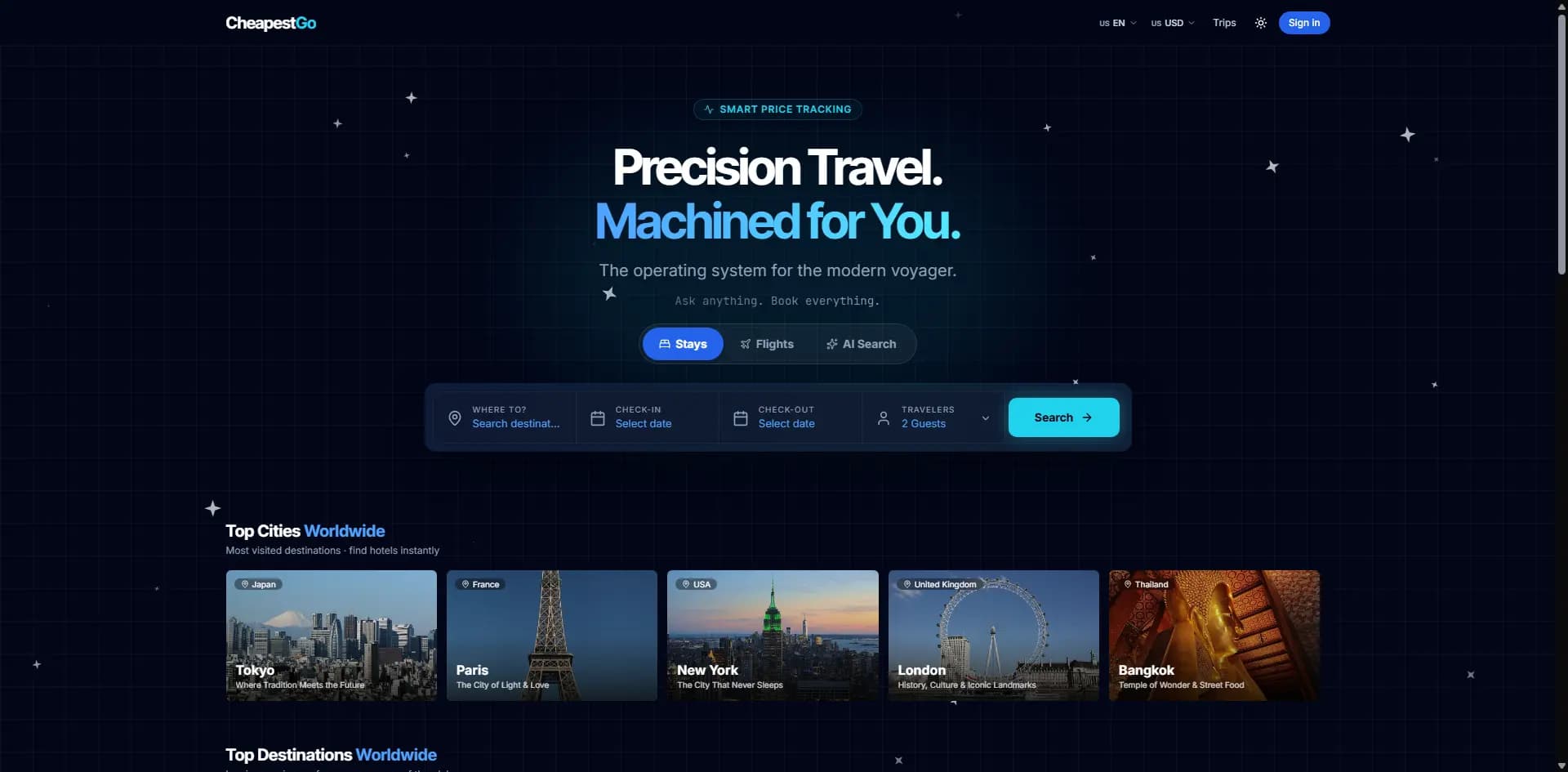
GeomeeGo has established itself as a dynamic search and booking platform that offers real-time access to inventory. Utilizing services from Duffel for live flight options and TravelgateX for hotel distribution, it features a price-tracking system that monitors routes across various airlines and properties continuously. Users can search, compare, and book seamlessly with immediate confirmations and secure checkout processes.
The platform functions beyond the traditional role of online booking systems. GeomeeGo is described as the operating system for today’s traveler—encouraging users to "ask anything, book everything." This reflects a more advanced concept than merely a search tool augmented by chat capabilities. It envisions a system that can articulate goals, compile evidence, act autonomously for the user, and transparently explain its operations afterward. This vision sets a higher standard than what most current AI-driven travel tools achieve, which GeomeeGo aims to surpass through its development of a Structured Cognitive Loop (SCL).
Current AI travel assistants face critical challenges with a common architecture where a single model manages all tasks: understanding user inputs, recalling past interactions, determining search parameters, interpreting outcomes, and executing bookings—all within the confines of a continuous text stream.
While this may work well in demonstrations, it frequently encounters challenges in practical applications. For example, as conversations extend, earlier details can become obscured. Ambiguities can arise in branching pathways. Mistakes may occur, such as selecting the wrong fare class or booking the incorrect date, with no clear resolution. When an error arises in these transactions, particularly in the context of financial commitments like tickets with cancellation penalties, a vague response of "the model was mostly right" fails to meet acceptable standards.
The SCL framework fundamentally transforms this process. It creates a cognitive structure that partitions the functionalities typically handled by one system into specialized components, each with a well-defined role:
1. Retrieval — Information is gathered at the outset of each engagement, remaining stable rather than being dynamically adjusted mid-conversation.
2. Cognition — The language model's role is to propose possible actions rather than make decisions autonomously.
3. Control — A distinct code oversees the proposed actions, ensuring they meet explicit preconditions, preventing any invalid actions from being executed.
4. Human-in-the-loop — For pivotal decisions, human stakeholders will verify conditions before final judgments are made.
5. Action — Only vetted proposals proceed to execution.
6. Memory — Documented accurate facts are stored, while unverified information is discarded.
At its core, this method emphasizes that the model does not act as an agent; instead, it operates as a cognitive processing tool within a structured sequence. Improvement in functionality arises from superior coordination rather than simply enhancing model complexity.
This structured approach has significant implications for travel booking. First, it delineates proposals from execution, ensuring that a recommendation for booking must get approval before actual transactions take place. For instance, if an agent proposes a rebooking when a flight is altered, only after confirming the parameters will the ticketing process be initiated.
Moreover, every decision made within this system generates a trace. Unlike traditional methods that may try to justify decisions post hoc, SCL logs the reasoning process in real-time—documenting the evidence used, the applicable rules, and the executed actions. This transparency is crucial for travelers, distinguishing between an ambiguous booking anomaly and a clear explanation as to why a particular choice was made. For enterprise partners and compliance frameworks, particularly under regulations like the EU AI Act, this clarity transitions the system from one that is auditable to one that isn't.
With this capability, users can express their travel desires more straightforwardly. Rather than searching explicitly, travelers can articulate intentions—such as scheduling a trip to Bangkok during late October with a budget not exceeding $600, preferring an aisle seat, and a hotel conveniently situated near a BTS station. The system retains these goals amid changing prices, assesses potential options against established criteria, and presents those that match the predefined conditions with a reasoned justification.
Furthermore, as the platform evolves, it enables autonomous tracking, allowing it to monitor prices and propose actions based on real-time evaluations, pausing for user confirmation before any financial commitments are made. This division facilitates low-cost autonomy where appropriate while maintaining human oversight where necessary.
GeomeeGo is also designed to handle complex trips without losing crucial details. Unlike traditional agents that can struggle with intricate itineraries, the structured memory prevents confusion, allowing for successful management of multi-faceted travel plans that cover flights, hotels, and other accommodations across different cities.
The future trajectory of travel commerce is leaning towards delegation. For years, travelers have relied on self-comparison of options. The evolving trend suggests that users will specify their goals—like destination, budget, and preferences—and allow the system to manage those goals as prices fluctuate.
However, effective delegation hinges on trust. A system that spends funds without a clear rationale poses a risk rather than a convenience. The true limiting factor for the advancement of AI travel lies not in the capabilities of the models themselves but their accountability. Travelers and partners will favor platforms that can substantiate their reasoning processes.
Expectations around traceability are likely to shift from being a unique feature to a common requirement in travel technology, fueled by growing traveler confidence and the demands for compliance from enterprise and agency partners. GeomeeGo aspires to set these standards proactively rather than reactively.
Jun Shin, the Chief Executive Officer of FORHU Inc, stated, "Travel is going to be booked by agents rather than by people clicking through search results. What nobody in this industry has answered is who is accountable when one of those agents gets it wrong." He emphasizes that the architecture must inherently provide that answer, which is why GeomeeGo is designed around a model where proposals are distinct from actions, and the sequence is transparent.
In terms of scope, GeomeeGo does not claim to create a flawless AI. Acknowledging the nature of errors as an unavoidable aspect of generative reasoning, the goal instead focuses on preventing incorrect assumptions from resulting in erroneous transactions. The targeted design emphasizes control, governance, traceability, and human supervision.
Currently, the integration of SCL into GeomeeGo is a part of the development roadmap but is not yet operational. The rollout is planned in stages, beginning with the search and monitoring functionalities before transitioning to execution-related bookings, maintaining transparency through the process.
GeomeeGo positions itself as a premier booking platform for discerning travelers, offering a global selection of flights and accommodations, supported by live inventory from Duffel and TravelgateX, with extensive operations across Asia-Pacific and beyond. The company underscores its commitment to data precision and uncompromising standards in travel booking. Further information can be found at geomeego.com and forhu.ai.
Sponsored Recommendations
Share this article