Technology
Top AI Legal Software Options for Law Firms in 2026: Five Notable Platforms
September 24, 20266 min read

Over the past two years, law firms have increasingly integrated artificial intelligence (AI) into their existing practice management systems. A select number of platforms are now gaining traction by focusing not just on paperwork but directly on the cases themselves.
This transformation in technology usage is evident in the day-to-day activities of legal professionals. Rather than relying on separate tools for research, document review, and client intake, many litigators are gravitating towards comprehensive platforms that manage the entire lifecycle of a case, from the initial client interaction to the preparation of evidence.
As the industry approaches the fourth quarter, here’s an overview of the current leading platforms.
ilovelawyer
What distinguishes ilovelawyer is not merely its promotional material but its practical functionality when a lawyer engages with a case file. By querying its built-in AI assistant, lawyers receive immediate responses, complete with real-time citations. These citations are verified against actual source documents, mitigating risks associated with inaccurate AI-generated information that has previously caused issues in court documents. Users can also upload documents for the assistant to search through.
Each case is assigned a dedicated workspace that organizes resources, communications, and AI-generated outputs on a single interface. This allows for the creation of visual mind maps outlining case issues and claims, the construction of chronological timelines, the extraction of structured fact tables from documents, or the drafting of briefs based on gathered information. Additionally, a unique audio function features two AI hosts discussing the case in a podcast-like format, which can serve as a quick briefing tool before hearings.
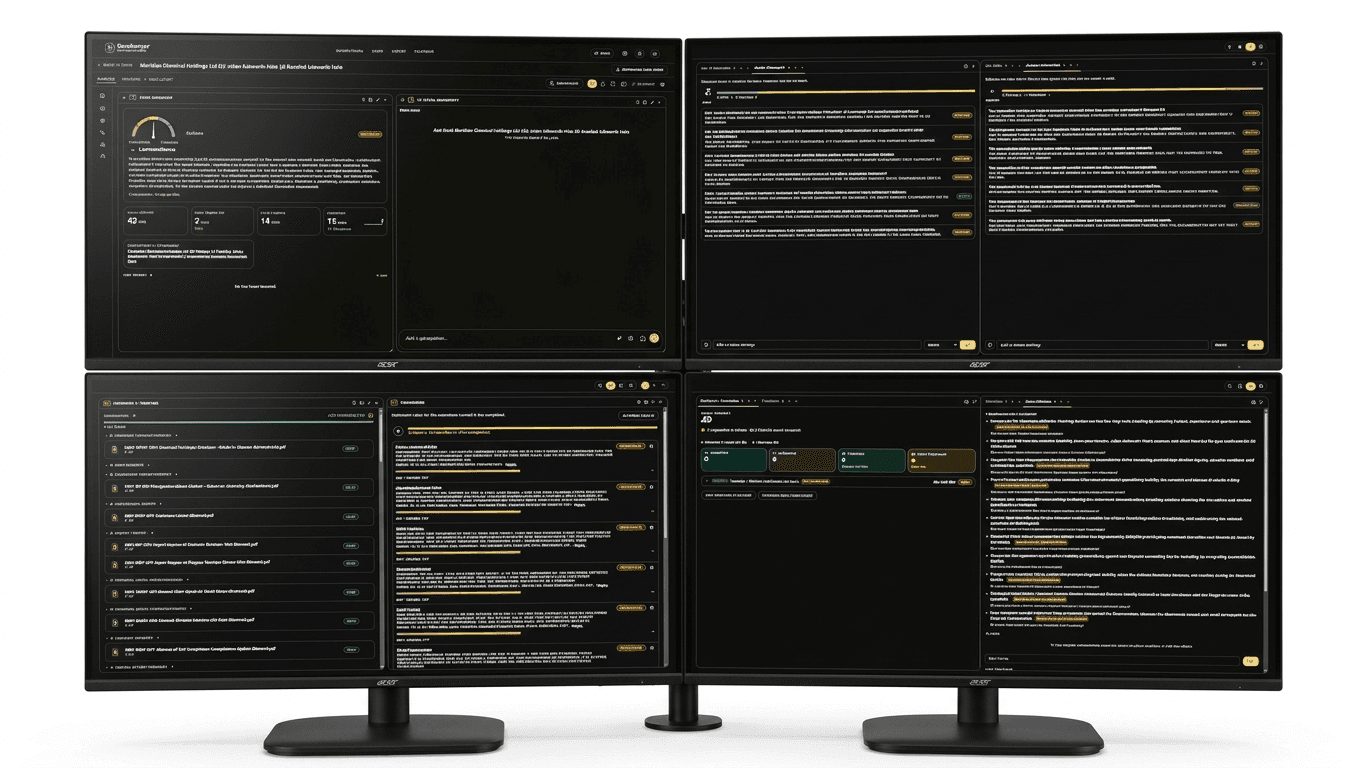
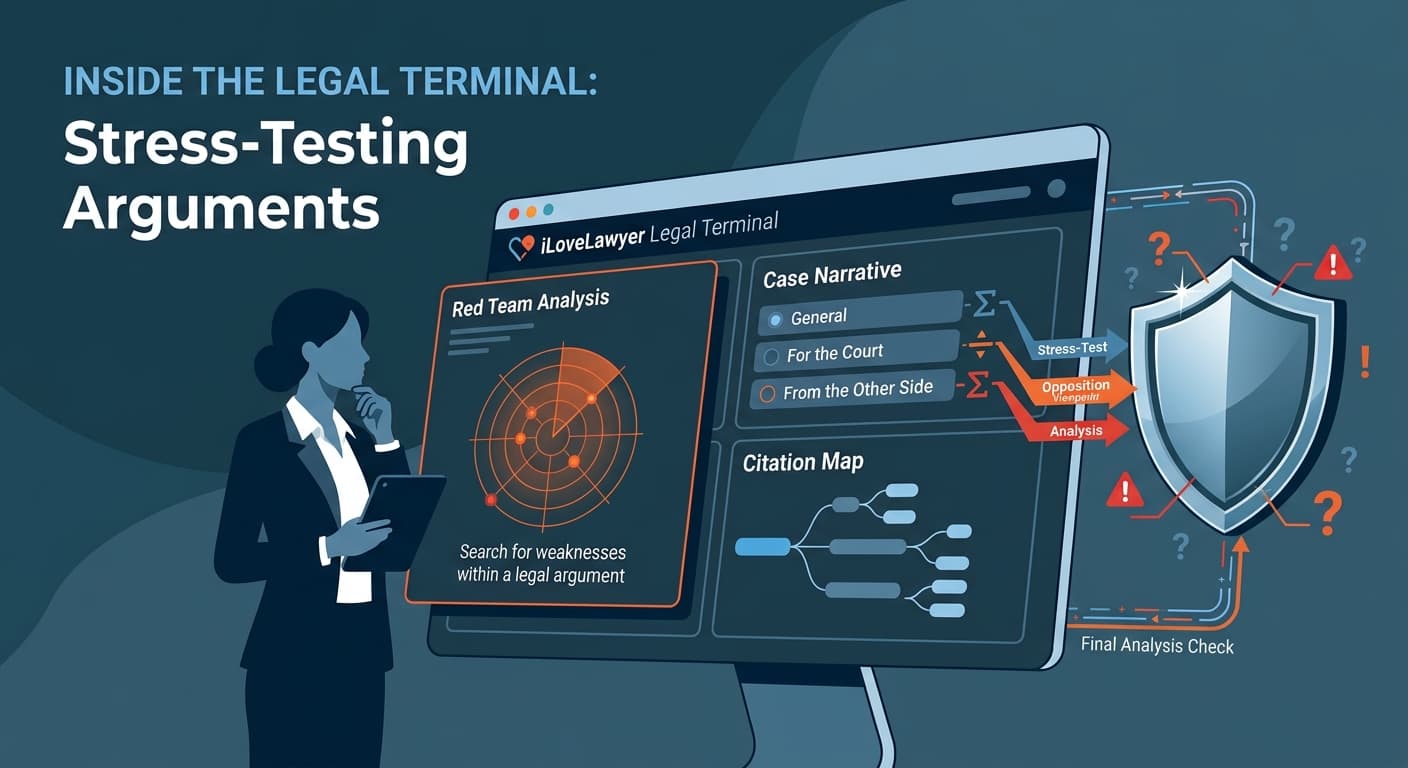
A standout component of ilovelawyer is the Legal Terminal, which provides a litigation workspace that can display up to nineteen customizable panes at once, with these configurations being saved and accessible across multiple devices. Key features include a "Red Team" pane that highlights possible arguments from opposing counsel, a reconstruction interface that presents various perspectives on the case—those of the client, the court, and opposing counsel—and a decision tracker that documents each conclusion reached by the AI, detailing the rules applied and the supporting evidence, along with a contradiction scan that detects inconsistencies within case documents and testimonies.
Supporting these features is a research library filled with legal case law and statutes, utilizing the same citation verification as found in the chat function. Standard case management capabilities are also integrated, including document storage, transcription services, and deadline monitoring, equipped with firm-level accounts for teams that require collective access.
Clio
Clio’s strength lies in its scalability. This practice management software has gained significant popularity among small and midsize law firms long before the term "legal AI" emerged. Its AI component, originally introduced as Clio Duo, has been rebranded to Manage AI this year. Rather than serving as an independent research tool, it interacts directly with a firm's existing Clio databases. This allows it to generate matter summaries based on current case data, evaluate uploaded documents for important terms and phrases, draft emails for clients, compose billing narratives, and auto-fill calendars with deadlines derived from court documents. This system reliably uses actual firm data, which can reduce the need for verification of its outputs. This aspect offers a significant advantage for firms hesitant about transferring away from Clio. However, the utility of Manage AI is contingent on the quality of the information it accesses from Clio, limiting its effectiveness for deep litigation strategy compared to some competing platforms.
NexLaw (ChronoVault)
NexLaw’s ChronoVault, part of its larger suite that includes a general AI assistant and a case preparation tool, addresses one specific need: creating a chronology from a multitude of case-related documents. It employs natural language processing and optical character recognition (OCR) technologies to extract dates, events, and involved parties from PDFs, emails, scanned documents, and witness statements. This information is then formatted into a searchable and filterable timeline, complete with annotation capabilities for court-ready export. According to NexLaw, this functionality significantly reduces the time traditionally spent compiling chronologies—from over 100 hours of manual effort to just a few minutes. However, the practical efficacy of such time savings should be evaluated through real-world case studies. Moreover, the platform upholds a zero-data-retention policy for enterprise clients, which is crucial for firms concerned about sharing privileged information with third-party systems. It is worth noting that while ChronoVault excels in building timelines, it does not function as a comprehensive case management system, serving instead as a specialized tool.
CS Disco
CS Disco has established its reputation in e-discovery even before generative AI became integrated into its offerings. Its AI tool, named Cecilia, is indicative of this legacy. Cecilia includes a Q&A feature that allows legal teams to inquire about an entire case file and receive citations for their answers. It also delivers single-document analyses, AI-generated summaries for depositions and documents, and timelines produced by its AI. In the context of document review, Cecilia can propose coding decisions, flag potentially privileged content, and highlight documents that may be overlooked by human reviewers. Recently, Disco enhanced Cecilia with an agentic layer targeting extensive cases involving millions of documents, implementing multi-step reasoning designed to reveal connections that simple keyword searches may miss. Importantly, Disco maintains that its underlying models do not learn from customer data and do not retain information post-query, a critical feature considering the sensitive materials handled by e-discovery platforms. However, its focus is primarily on discovery and review tasks rather than everyday case management.
MyCase
MyCase has been expanding its AI functionalities over the past year, branding its AI layer as MyCase IQ, now known as 8am IQ, following a recent partnership disclosed during the company's user conference. The tools focus on the operational demands of small-to-midsize practices rather than litigation strategies. Features include an AI writing assistant that refines client emails and case notes, a translation tool that maintains legal accuracy across languages, and the automatic summarization of uploaded documents. A new addition, the Case Assistant, allows users to pose natural-language questions regarding a matter's case and financial data, providing responses directly from the firm's records, which includes automated time entries. This tool is offered as an optional upgrade to MyCase’s Pro plan, an important consideration for firms assessing total expenditures. For practices facing challenges from administrative workloads rather than in-depth research needs, MyCase presents a more immediate practical solution compared to platforms centered on litigation strategies.
The conclusion
Navigating the landscape of these five software solutions prompts firms to answer a key question: do they require a versatile tool that addresses the entire scope of a case, or a specialized tool that excels at a particular function? Clio and MyCase extend existing systems that many firms are already utilizing, providing favorable migration alternatives at the expense of some depth. Conversely, NexLaw and Disco specialize in specific functions—timeline creation and discovery processes, respectively—that a more general tool may not tackle as effectively. Among those evaluating a comprehensive litigation workspace versus a collection of specialized solutions, ilovelawyer emerges as the platform with the broadest capabilities.
Sponsored Recommendations
Share this article